What Is DoxyPEP and What Does It Not Prevent?
DoxyPEP is a doxycycline dose taken after sex to lower the risk of syphilis, chlamydia and gonorrhea. Learn what it does not prevent, including HIV and herpes.
By Mpact Global12 min read
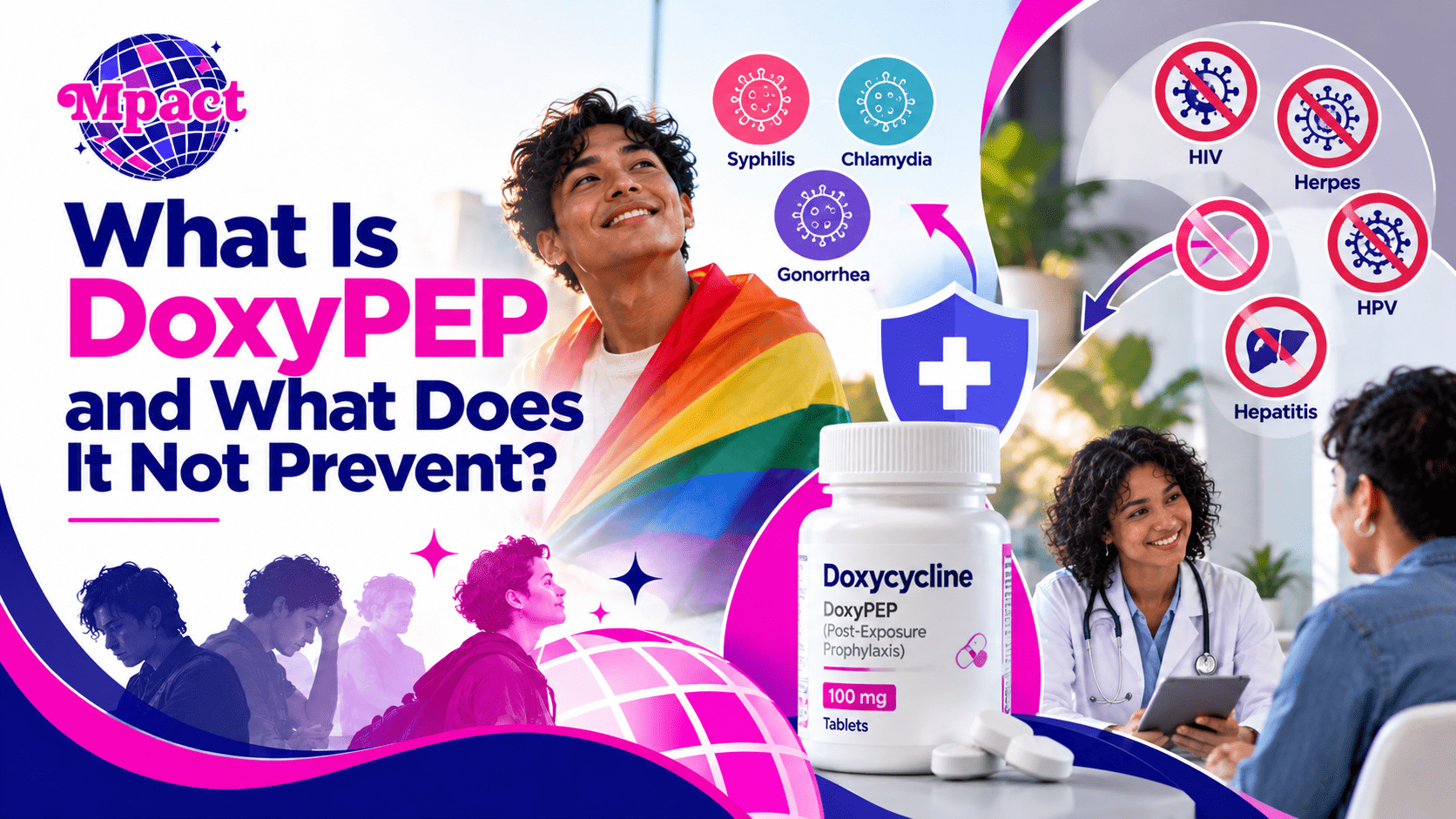
DoxyPEP is a single dose of the antibiotic doxycycline taken after sex to lower the chance of getting certain bacterial sexually transmitted infections (STIs). It can help prevent syphilis and chlamydia, and to a lesser degree gonorrhea. It does not prevent HIV, herpes, HPV, hepatitis or other viral infections.
That gap matters. The name sounds a lot like HIV PEP, and some people assume one pill covers everything. It doesn't, and mixing the two up can leave you unprotected against HIV.
What is DoxyPEP?
DoxyPEP (also written doxy-PEP) stands for doxycycline post-exposure prophylaxis. "Post-exposure prophylaxis" means taking a medicine after a possible exposure to stop an infection from taking hold.
Doxycycline is a common, inexpensive antibiotic from the tetracycline family. Doctors already use it to treat chlamydia and to prevent malaria and Lyme disease. According to the CDC's 2024 doxyPEP guidelines, it is well absorbed and generally well tolerated, though it had not been used to prevent STIs until recently.
With doxyPEP, a provider writes a prescription you keep on hand. You take one dose after sex, within a set time window, rather than taking an antibiotic every day.
Here's doxyPEP at a glance.
Topic | Key information |
What it is | A 200 mg dose of doxycycline taken after sex |
Timing | As soon as possible, and no later than 72 hours after oral, anal or vaginal sex |
Maximum dose | No more than 200 mg in any 24-hour period |
May help prevent | Syphilis, chlamydia and some gonorrhea |
Does not prevent | HIV, herpes, HPV, hepatitis B and C, mpox and other viral infections |
Main group recommended | Gay, bisexual and other men who have sex with men and trans women who had a bacterial STI in the past 12 months (CDC) |
Ongoing care | STI testing every 3 to 6 months and a regular check on whether you still need it |
Main concerns | Side effects and antibiotic resistance |
Prescription | Required. Never use leftover or borrowed antibiotics |
How does DoxyPEP work?
Syphilis, chlamydia and gonorrhea are all caused by bacteria, and doxycycline can kill or stop the growth of many bacteria. Taking a dose soon after sex puts the antibiotic in your body while any bacteria passed on are still few in number. The aim is to stop an infection before it can take hold.
That is also why doxyPEP has limits. Antibiotics only work on bacteria. They have no effect on viruses such as HIV, herpes or HPV.
DoxyPEP is described as "patient-managed" in the CDC guidelines. You keep the prescription at home and take a dose yourself after sex, without a clinic visit each time. Your provider still checks in with you every 3 to 6 months.
How is DoxyPEP different from other prevention methods?
The names are similar, so it helps to compare them side by side.
HIV PEP is a 28-day course of HIV medicines started within 72 hours of a possible HIV exposure. The CDC describes it as an emergency option. It protects against HIV only.
HIV PrEP is HIV medicine taken before exposure, as daily pills or long-acting injections. It protects against HIV only.
DoxyPEP is a single antibiotic dose taken after sex. It lowers the risk of some bacterial STIs and has no effect on HIV.
Condoms lower the risk of HIV and many other STIs when used correctly every time.
Many people who use doxyPEP also use HIV PrEP. The two do different jobs and don't replace each other.
Which bacterial STIs can DoxyPEP help prevent?
DoxyPEP has been studied for three bacterial STIs: syphilis, chlamydia and gonorrhea. It works well against the first two and less reliably against gonorrhea.
The CDC guidelines summarize three large randomized trials in gay, bisexual and other men who have sex with men and trans women. In those trials, 200 mg of doxycycline taken within 72 hours after sex cut syphilis and chlamydia infections by more than 70% and gonorrhea by about 50%. In May 2026, the World Health Organization (WHO) reached a similar view: doxyPEP can reduce syphilis and chlamydia and may also reduce gonorrhea in some settings.
Here's what the evidence shows for each infection. These are trial results in specific groups, not a promise of protection for any one person.
Infection | What the evidence shows | Important limitations |
Syphilis | Strong reductions (more than 70%) in trials of men who have sex with men and trans women | Evidence comes mainly from those groups. Regular syphilis blood tests are still needed |
Chlamydia | Strong reductions (more than 70%) in the same trials | A trial in cisgender women in Kenya found no significant reduction |
Gonorrhea | About 50% reduction overall, with mixed results between studies | One early trial (IPERGAY) found no significant effect. Many gonorrhea strains already resist tetracycline antibiotics |
Why are gonorrhea results weaker?
Gonorrhea is good at developing resistance to antibiotics. The CDC notes that doxycycline is no longer a recommended gonorrhea treatment because of resistance, though it still works against many US strains. In the French DOXYVAC study, every gonorrhea sample tested at the start was already resistant to tetracycline. That helps explain why results vary so much from place to place.
What about cisgender women?
The only trial in cisgender women, the dPEP Kenya study, found no significant drop in bacterial STIs. Hair tests showed only 29% of women in the doxycycline group had actually been taking it, so low use may explain the result. Researchers haven't ruled out biological differences either.
What does DoxyPEP not prevent?
DoxyPEP does not prevent HIV or any other viral STI. Doxycycline is an antibiotic, and antibiotics don't work on viruses.
It's also only been tested against syphilis, chlamydia and gonorrhea. The CDC's evidence review looked at those three infections and nothing else, so there's no proof it protects against other bacterial or parasitic infections either.
Each of these infections spreads in its own way and has its own prevention tools.
Infection | What you should know | Prevention or next step |
HIV | DoxyPEP gives no protection against HIV | HIV PrEP before exposure, or HIV PEP within 72 hours after a possible exposure. Condoms and regular HIV testing |
Herpes (HSV) | A virus, so an antibiotic has no effect | Condoms lower the risk. Talk to a provider about testing and treatment if you have symptoms |
HPV | A virus that can cause genital warts and some cancers | The HPV vaccine |
Hepatitis B | A virus spread through sex and blood | The hepatitis B vaccine and testing |
Hepatitis C | A virus, mainly spread through blood | Testing, plus avoiding shared needles and other equipment |
Hepatitis A | A virus that can spread through sex | The hepatitis A vaccine |
Mpox | A virus spread through close contact, including sex | The mpox vaccine |
Other STIs | Not studied in doxyPEP trials | Regular STI testing and condoms |
The CDC guidelines recommend that providers offer people on doxyPEP vaccines for hepatitis A and B, mpox and HPV, and testing for hepatitis B and C, where needed.
Does DoxyPEP prevent HIV?
No. DoxyPEP and HIV PEP are different medicines with different jobs. If you think you've been exposed to HIV, you need HIV PEP within 72 hours, and the sooner the better.
If you're at ongoing risk of HIV, HIV PrEP is the tool built for that.
Does DoxyPEP prevent herpes, HPV or hepatitis?
No. These are all viruses. Vaccines are available for HPV and hepatitis A and B, and condoms lower the risk of many viral STIs.
Who may benefit from DoxyPEP?
Current guidance focuses on gay, bisexual and other men who have sex with men and trans women, because that's where the strongest evidence is. Bacterial STIs also affect these groups disproportionately, according to the CDC.
Guidelines differ a little by country, so here's how the main ones compare:
United States (CDC, June 2024): Providers should talk with gay, bisexual and other men who have sex with men and trans women who had syphilis, chlamydia or gonorrhea in the past 12 months, and offer doxyPEP through shared decision-making. They may also discuss it with people in these groups who haven't had a recent STI but expect to be at higher risk.
World Health Organization (May 2026): doxyPEP may be offered to men who have sex with men and trans women as part of a wider sexual health package. WHO says to prioritize people with recent or repeated STIs, especially syphilis, and to monitor antibiotic resistance.
United Kingdom (BASHH, June 2025): The UK's first clinical guidelines mainly recommend doxyPEP for gay and bisexual men and trans women at higher risk of syphilis.
For everyone else, including cisgender women, heterosexual men, trans men and nonbinary people assigned female at birth, the CDC makes no recommendation either way. The evidence is too limited. A provider may still discuss it case by case.
Guidance also varies within regions and changes as new evidence comes in. A local sexual health clinic can tell you what applies where you live.
How is DoxyPEP used?
DoxyPEP is only taken with a prescription and a plan agreed with a healthcare provider. Here's what the CDC guidelines say about how it's used:
Dose: 200 mg of doxycycline, in any formulation.
Timing: As soon as possible after oral, anal or vaginal sex, and no later than 72 hours. In the trials, people were told to take it ideally within 24 hours.
Limit: No more than 200 mg in any 24-hour period, even if you have sex several times that day.
Supply: Your provider prescribes enough doses to last until your next visit, based on your situation.
Follow-up: STI testing at baseline and every 3 to 6 months, plus a regular check on whether you still need doxyPEP.
The CDC also advises taking each dose with food and a full glass of water, and not lying down for an hour afterward. That helps prevent irritation of the esophagus (food pipe). Doses should be kept at least 2 hours apart from dairy products, antacids and supplements with calcium, iron or magnesium, which can block absorption.
Don't use leftover antibiotics or tablets from a friend. The wrong drug or dose may not protect you, and unnecessary antibiotic use adds to resistance. A clinical guideline hosted by the NIH also notes that doxyPEP shouldn't be combined with other tetracycline antibiotics, such as those taken for acne or malaria prevention.
What are the side effects and risks of DoxyPEP?
Most people tolerate doxycycline well, and serious side effects are rare. But it's still an antibiotic, and taking it often has costs.
Common side effects
The CDC guidelines list these as the main known side effects:
Nausea, vomiting or diarrhea
Heartburn or pain from irritation of the esophagus
Sensitivity to sunlight (sunburning more easily)
In the trials, few people stopped because of side effects. In the DOXYVAC study, under 1% stopped doxyPEP for stomach problems or worry about side effects.
Pregnancy
Doxycycline is generally not used during pregnancy because of possible effects on the fetus. Anyone who could become pregnant should raise this with their provider before starting.
Antibiotic resistance
Resistance is the biggest open question. The more often bacteria meet an antibiotic, the more chances they get to evolve around it. The CDC points to three concerns from the research so far:
Gonorrhea: Many strains already resist tetracyclines, and doxyPEP may add to that.
Other bacteria: In the DoxyPEP trial, the share of people carrying tetracycline-resistant Staphylococcus aureus (a common skin bacterium) rose from 5% to 13% after a year.
The microbiome: No studies yet show the long-term effect of on-and-off doxycycline use on the healthy bacteria in your gut.
The CDC judged that the benefits outweigh the known risks for the groups it recommends doxyPEP for, while stressing that long-term risks are unknown. WHO likewise asks countries using doxyPEP to monitor resistance. This is one reason guidelines target people at the highest STI risk rather than everyone.
How does DoxyPEP fit into a wider STI prevention plan?
DoxyPEP is one tool among several, and none of them covers everything. The CDC says doxyPEP should always come as part of a full sexual health approach that includes:
Regular STI testing every 3 to 6 months, at every body site used for sex. DoxyPEP isn't 100% effective, so infections can still happen and need treatment.
HIV prevention, such as PrEP, HIV PEP after a possible exposure and regular HIV testing.
Vaccines for hepatitis A and B, HPV and mpox where recommended.
Condoms, which lower the risk of HIV and many STIs that doxyPEP can't touch.
Linking people living with HIV to care.
These tools do different jobs, so they aren't interchangeable. The right mix depends on your health, your sex life and what's available where you live, and a provider can help you work it out.
Mpact has worked on sexual health for gay, bisexual and queer communities for 20 years. It doesn't prescribe medicine or offer testing, but it does share community resources. Its vaccination campaign explains why vaccines matter for queer sexual health. Its MSM Implementation Toolkit gives health workers and community groups practical guidance on running HIV and STI programs with men who have sex with men.
The bottom line on DoxyPEP
DoxyPEP is a single 200 mg dose of doxycycline taken within 72 hours after sex. In trials of gay, bisexual and other men who have sex with men and trans women, it cut syphilis and chlamydia by more than 70% and gonorrhea by about half.
It does not prevent HIV, herpes, HPV, hepatitis, mpox or any other viral infection. It also carries side effects and a real risk of adding to antibiotic resistance, which is why guidelines focus on people at the highest risk of bacterial STIs.
If you think doxyPEP could help you, talk to a sexual health clinic or a provider you trust. They can check whether it suits you, set up regular testing and help you build a prevention plan that also covers HIV. To learn more about sexual health and HIV prevention in queer communities, read Mpact's 10-Year PrEP Report or browse the Mpact blog.
This article is for general information only and isn't medical advice. Talk with a qualified healthcare provider about your own situation.
Frequently asked questions
The global attention paid to the sexual health and human rights of men who have sex with men is shrinking. That’s why we need your support.